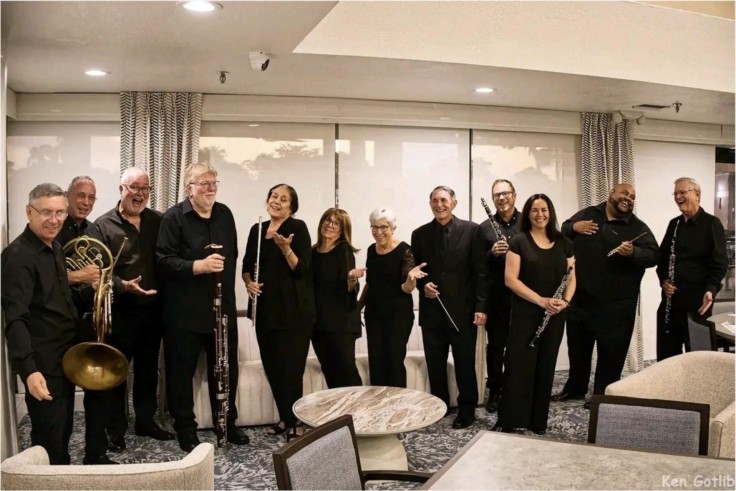
In South Florida's chamber music scene, French horn player Ivan Lypovyk has found a new artistic home — and a fresh canvas for his global expertise — with New Directions Chamber Winds. As Principal Horn of the ensemble, he brings to the stage a formidable career shaped by elite Ukrainian conservatory training, European opera and ballet productions, and major North American tours. His latest chapter is a powerful story of relocation, resilience, and unyielding artistic drive.
New Directions Chamber Winds reimagines grand symphonic and orchestral repertoire for a more intimate wind-ensemble format. In this intimate setting, there is nowhere to hide: each player carries an independent line while weaving their voice into the group's overall sound. For Lypovyk, who transitions seamlessly between massive opera houses and intricate chamber spaces, this format is the perfect showcase for his versatile artistry.
Lypovyk's distinguished path began in Ukraine, where he honed his craft at the National Music Academy of Ukraine. It was here that he forged the rigorous academic foundation and fierce performance discipline that would later propel his work across the global stage. Before establishing himself in the United States, he commanded stages across Ukraine and Europe as both a soloist and principal horn player. His early career already read like thatof a seasoned veteran, featuring participation in more than fifty major productions, including twelve highly anticipated premieres of operatic and symphonic works.
Much of that early artistry was forged in the demanding world of opera and ballet. His high-profile collaborations with companies under the direction of the renowned conductor Alexei Baklan launched him into European engagements spanning Spain, Germany, and the Netherlands. These projects immersed him in the high-stakes environment of international touring—a professional proving ground where a musician must adjust instantly to unfamiliar acoustics, grueling rehearsal schedules, and the highest artistic expectations.
Opera and ballet demand a razor-sharp, multifaceted discipline from orchestral musicians. In the pit, a player cannot simply focus on the conductor and the score; they must breathe in sync with singers, anticipate the physical leaps of dancers, and remain hyper-aware of stage timing and the fluid movement of the production as a whole. For Lypovyk, this high-pressure environment honed the very instincts that define his chamber performance today: an extraordinary ability to listen across the ensemble, anticipate micro-shifts, and sculpt his sound in real time.
One standout chapter from that period was a celebrated series of performances of Beethoven's Symphony No. 9 in Spain. Lypovyk performed at the prestigious Palau de la Música Catalana in Barcelona before taking the masterpiece to seven additional cities. For horn players, Beethoven's Ninth is the ultimate crucible — a serious test of stamina, precision, and artistic judgment. The demanding writing requires the player to masterfully balance raw orchestral force with delicate restraint, ensuring the integrity of the larger structure remains flawless. A live recording of Ivan Lypovyk performing this repertoire, showcasing the depth and nuance of his phrasing, can be viewed here.
While the Barcelona performance placed him on one of Europe's most venerated stages, the true triumph of the project was found in its grueling, cumulative nature. Repeating a work of Beethoven's scale across multiple cities deepens a master musician's relationship to the score. Each hall presents a unique acoustic puzzle, altering the balance and demanding focused attention. The true artistic achievement goes far beyond simply playing the notes correctly. It lies in preserving the emotional weight and integrity of the musical line even under constantly shifting conditions.
Lypovyk's international reputation naturally extended to North America through the acclaimed Kyiv Musical Mission, under the baton of renowned American conductor Roger McMurrin. This major project brought monumental choral and orchestral masterpieces, such as Handel's Messiah, to audiences across the United States and Canada. The historic tour culminated in a performance at New York's legendary Carnegie Hall, alongside appearances in major concert venues nationwide.
The mission-driven character of that project elevated the performances, infusing them with a purpose that resonated far beyond the concert platform. These were more than just presentations of major sacred works, as they became profound cultural encounters. They bridged worlds, bringing elite Ukrainian-trained musicians into direct conversation with North American audiences through a repertoire deeply rooted in Western choral and orchestral tradition. For Lypovyk, this experience added a profound new dimension to an already formidable performance background.
Earlier in his career, Lypovyk lent his talents to Troika Entertainment (now Crossroads Live North America), a titan in the production of touring Broadway shows. During the 1999–2000 season, he was selected for Music of the Night, a large-scale national production celebrating the music of the legendary Andrew Lloyd Webber. This demanding national U.S. tour called for an entirely different echelon of musical flexibility. For Lypovyk, his rigorous classical training had to seamlessly adapt to the razor-thin timing, complex phrasing, and dynamic coordination demands of theatrical performance—where the orchestra must flawlessly synchronize with singers, staging, lighting, and dramatic pacing from night to night.
In 2003, Lypovyk joined a production of Leonard Bernstein's West Side Story at the historic La Scala in Milan, performing under conductor Donald Chan, a leading authority on the Bernstein repertoire. The production expanded into a tour of Japan, with engagements in Tokyo, Osaka, Nagoya, and Fukuoka. This project added yet another dimension to a career already spanning opera, symphonic music, sacred repertoire, and musical theater.
West Side Story occupies a distinctive place in twentieth-century music — brimming with theatrical energy, intricate rhythms, and a unique fusion of jazz, classical composition, and American popular idioms. For orchestral musicians, Bernstein's score demands absolute precision, style, and a keen sensitivity to the stage. For Lypovyk, this engagement provided a deep immersion into a musical language that contrasts sharply with the European traditions of his conservatory training.
The next major turn in his life was dictated not by professional schedules but by history. In early 2022, Lypovyk arrived in the United States for what was intended to be a temporary visit. The outbreak of the full-scale war in Ukraine abruptly transformed this stay into the beginning of a challenging new chapter.
Choosing to remain in the United States, he continued to perform, anchoring his new work in a wealth of experience formed in Ukraine and tested across international stages. For many Ukrainian artists, the war redefined what it meant to continue a professional career. Performance became more than just work. It turned into a way of preserving identity, memory, and cultural connection amid constant upheaval. Lypovyk's work in Florida is part of that larger story, reflecting the practical reality of a musician rebuilding artistic momentum from the ground up.
In Florida, Lypovyk found a new artistic home in New Directions Chamber Winds, an ensemble led by conductor Michael Herzlin. An NYU graduate, Herzlin brings a distinguished background that includes collaborations with the Metropolitan Opera, the American Symphony Orchestra, and the Royal Ballet.
Under Herzlin's direction, the ensemble has developed a sound characterized by clarity, balance, and meticulous attention to detail. The ensemble's repertoire is often written or arranged for a double quintet of woodwinds and horn — a rare format that exposes the nuances of each individual part far more than a standard orchestral setting. In this configuration, the horn stands exposed, without the support of a full section. Lypovyk's line shifts fluidly — adding warmth beneath the woodwinds, providing a central sonority in the middle register, or illuminating key structural moments.
Within this framework, Lypovyk's role as Principal Horn serves as a vital bridge, connecting his extensive orchestral and theatrical experience with the ensemble's present work in South Florida. The position demands far more than technical accuracy. It requires the sensitivity to anchor the ensemble's blend, respond instinctively to subtle changes in phrasing, and maintain the horn's presence without overpowering the surrounding texture.
This delicate balance is central to Lypovyk's current work. His career unfolds across European opera houses, North American concert halls, touring Broadway productions, and now a Florida chamber group focused on reimagining orchestral repertoire in a compact format. Across these diverse settings, the horn's role evolves, but the fundamental responsibility remains immediate: to give shape, color, and direction to the music around it.
There is also a local dimension to this chapter. South Florida's cultural landscape is shaped by migration, international backgrounds, and a constant meeting of artistic traditions. In this environment, New Directions Chamber Winds does more than merely present familiar repertoire in a smaller format. It fosters a space where artists weave their distinct professional histories into a shared performance.
For Lypovyk, this setting harmonizes the diverse strands of his career: the discipline of conservatory training, the adaptability of international tours, the theatrical instinct developed on Broadway, and the acute ensemble awareness refined in opera and ballet pits. Rather than marking a break from his past, this Florida chapter distills a lifetime of international experience into a smaller, more immediate musical setting.
For audiences in South Florida, that experience now arrives in its most intimate form. The musician who once performed on world-renowned stages now enriches a local ensemble working to bring orchestral color into chamber performance. His story is less a catalogue of past engagements than a portrait of a musician carrying a singular artistic life across countries, repertoires, and unexpected historical turns.
© 2026 MusicTimes.com All rights reserved. Do not reproduce without permission.


