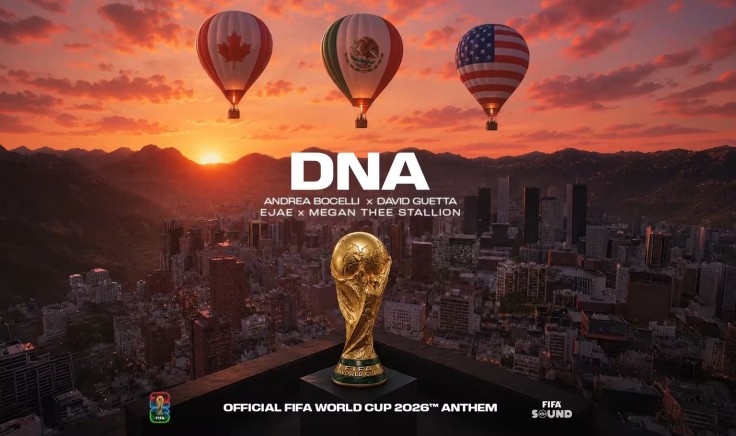
The 2026 FIFA World Cup is officially underway — and its first major musical statement is one of the strangest, most ambitious lineups ever assembled for a sporting anthem.
FIFA unveiled "DNA" today, the official anthem for the 2026 tournament, performed by Italian opera tenor Andrea Bocelli, Grammy-winning rapper Megan Thee Stallion, global DJ and producer David Guetta, and Korean-American singer-songwriter EJAE. The track is available now on all major streaming platforms, and Bocelli and EJAE performed it live for the first time at the opening ceremony at Estadio Azteca in Mexico City on June 11, as the tournament kicked off with Mexico facing South Africa.
It is, on paper, a lineup that should not work. In practice, it may be the most deliberately global thing FIFA has ever put its name on.
Why 'DNA' Stands Out
FIFA has long used official songs and anthems to accompany the World Cup. The formula has usually been consistent: a pop star, a feel-good beat, and lyrics about unity. "DNA" does not follow that formula.
Bocelli brings classical tenor vocals and decades of international acclaim as one of the best-selling artists in classical music history. Megan Thee Stallion brings three Grammy wins and one of the most commercially dominant rap careers of the last five years. David Guetta — who has produced or co-written records for Sia, Nicki Minaj, Rihanna, and Bebe Rexha — helms the production and anchors the track in stadium-scale EDM. And EJAE, the Korean-American singer-songwriter behind the global hit "Golden" from Netflix's animated film KPop Demon Hunters, contributes a vocal and lyric perspective that no previous World Cup anthem has had.
Opera. Rap. EDM. K-pop. All four in the same song, for the same tournament.
The production intentionally reflects the structure of the 2026 World Cup itself — the first edition to be hosted across three countries (the United States, Mexico, and Canada), with 48 teams competing across 16 cities. "DNA" was designed as a track where no single genre or region dominates. Whether it achieves that balance will be for listeners to judge; that it attempted it at all is genuinely unusual.
EJAE's Full-Circle World Cup Moment
Of the four artists on "DNA," EJAE is the one most likely to be overlooked by mainstream sports coverage — and the one with the most personal connection to the tournament.
In 2002, South Korea co-hosted the FIFA World Cup alongside Japan. EJAE was a child in Seoul when the South Korean national team reached the semifinals — still the country's best-ever World Cup result — and the city transformed into something she has described as unlike anything she experienced before or since.
Twenty-four years later, she is on the official anthem.
"Being a part of the Official FIFA World Cup Anthem means so much to me," EJAE said in a statement released alongside the track. "It's especially meaningful because I was able to write Korean lyrics in the song — representing South Korea on this stage is such an honour."
Those Korean lyrics are a rare inclusion in FIFA World Cup music — and for K-pop audiences, a fanbase that has spent years watching Korean artists navigate international stages built for other sounds, the detail will not go unnoticed.
EJAE's presence on "DNA" also extends a run that began with "Golden" becoming a global breakout hit following its release on Netflix — a song that topped the Billboard Hot 100, won the Oscar for Best Original Song at the 98th Academy Awards, and made history at the Grammys as the first K-pop song to win Best Song Written for Visual Media. FIFA's decision to include her is a signal that the organization is tracking where global music attention has moved, not just where it has historically been.
Anthem vs. Official Song: What's the Difference?
A detail worth clarifying for anyone following the World Cup's music rollout: "DNA" is not the only track FIFA has released for 2026, and it serves a specific function that is different from the other one.
"DNA" is the official anthem — the ceremonial track that will play at kickoff moments, broadcast intros, and official FIFA presentations throughout the tournament. It is the sonic identity of the event itself.
Shakira and Burna Boy's "Dai Dai," released May 15, is the official song of the tournament — designed for playlists, stadium atmosphere, and popular airplay. Where "DNA" is built for ceremony, "Dai Dai" is built for the crowd. Shakira, whose "Waka Waka (This Time for Africa)" remains one of the most-streamed World Cup tracks in history, returns to a role she knows well. The split between the two is intentional: FIFA is running two parallel musical strategies simultaneously.
Both tracks benefit from the same 38-day window. With the tournament running through July 19's final at MetLife Stadium in New Jersey, both songs will remain part of the tournament's soundtrack throughout its 38-day run.
What to Watch
"DNA" drops into a streaming environment on one of the highest-traffic sports days of the year. First-week numbers will indicate whether the genre-blending approach lands with general audiences or primarily with the existing fanbases of each artist. For EJAE specifically, the World Cup stage is the largest platform she has had since "Golden" — and the K-pop audience, which has proven itself capable of coordinated streaming campaigns, will be watching closely.
Whether "DNA" becomes a streaming hit remains to be seen. But on opening day of the world's biggest sporting event, FIFA has already accomplished something unusual: it created a World Cup anthem that sounds like the world it claims to represent.
© 2026 MusicTimes.com All rights reserved. Do not reproduce without permission.


