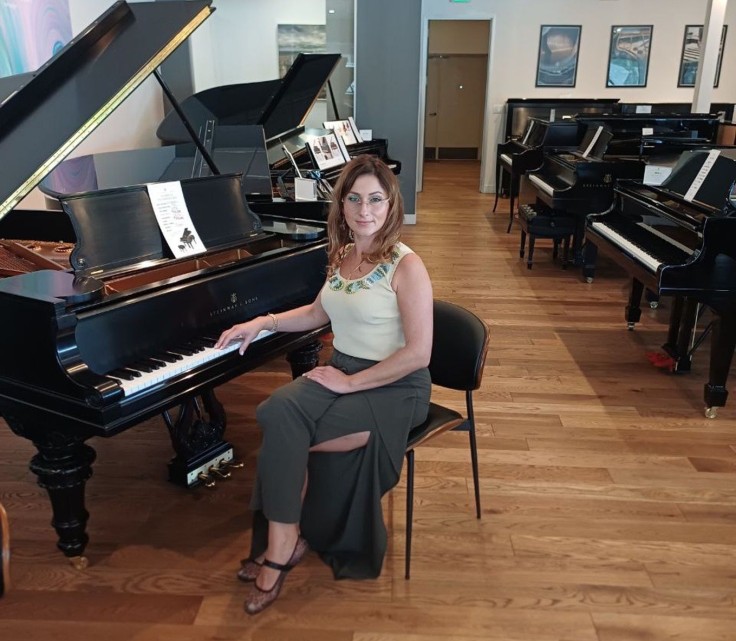
There are piano teachers, and then there are artists who reshape what music education can be. Ukrainian-born pianist and educator Nataliia Batenova belongs firmly in the second group—quietly, steadily transforming how children and adults experience the piano from conservatories in Lviv to community centers in Huntington Beach, California.
For more than a decade, Batenova has lived in two worlds at once: the rigorous, high-level classical tradition of Europe's music academies and the intimate, emotional world of the beginner's first lesson. Trained at the National Academy of Music "Mykola Lysenko" in Lviv, where she earned both her Master's degree in Musical Art and postgraduate specialization in chamber ensembles, she built her early career as a concert performer, accompanist, and ensemble artist across Ukraine, the European Union, the UAE, and Bahrain. Those years on stage—as a soloist, chamber musician, and accompanist—now form the backbone of a teaching style that treats every student like a performer in the making, not just someone learning notes on a page.
Her story as an educator truly takes off in Lutsk, Ukraine. There, Batenova opened her own piano studio in 2015 and began developing a comprehensive approach that blends performance, music theory, and musicology into a seamless learning experience. Practical lessons are never just about "getting the piece right"; they're woven together with history, structure, and listening skills so students understand why a piece sounds the way it does and how to express it. Over time, she curated teaching materials tailored to each student—children, teenagers, and adults up to age 40—and focused on building long-term, trusting relationships based on respect, curiosity, care, and genuine attention to each personality.
The results quickly spoke for themselves. Her students began earning laureate titles at Ukrainian and international competitions—more than fifteen in total—and regularly performed at recitals Batenova organized, with over 80% of her studio taking the stage. Performance wasn't treated as a rare, terrifying moment but as a natural extension of the learning process. Alongside technique and repertoire, she helped students work through stage fright and anxiety, teaching them how to stand in front of an audience and believe in their own sound.
At the same time, Batenova refused to let music education become a privilege reserved only for families who could afford it. She offered free piano lessons to talented children from low-income backgrounds so they could prepare for competitions and gain access to opportunities that might otherwise have been out of reach. For her, the piano is not just an instrument—it's a social elevator, a way to give a child a different sense of what might be possible in their life.
In 2021, she took a major step forward and officially founded LaPiano, a private music school that began in Lutsk and later expanded its activity to Huntington Beach, California. As founder, owner, and music mentor, Batenova leads a team of teachers, coordinates schedules and curricula, and keeps a close eye on the overall quality of instruction. Under her leadership, LaPiano's student base has grown by approximately 30–35% each year, driven not by aggressive marketing but by word-of-mouth and visible results: confident young pianists, engaged adult learners, and families who feel part of a real musical community.
What truly sets LaPiano apart is Batenova's willingness to blend the conservative rigor of European music academies with modern, student-centered methods. She has mastered and implemented the Trinity College London examination system, giving her students access to an internationally recognized framework for measuring their progress. At the same time, she has invested in psychology courses focused on working with children, integrating what she learned into everyday lessons—from how she gives feedback to how she helps students set realistic goals and celebrate small victories.
Her work, however, doesn't stop at the doors of her school. Throughout her career, Batenova has maintained an active life as a performer: playing as a soloist, accompanist, and chamber ensemble artist across Europe, the UAE, and Bahrain; working as an accompanist at the National Academy of Music in Lviv; and even collaborating with the ballet school "Elba Dance" in Portoferraio, Italy. There, she served as accompanist for dancers from 2022 to 2023, honing her sensitivity to movement, timing, and atmosphere—skills that later feed back into how she teaches phrasing and rhythm to her piano students.
Today, based in Huntington Beach, Batenova is channeling her experience into community service in the United States. Since September 2024, she has been actively involved in Community Music Outreach, performing as a volunteer piano soloist in churches, community centers, nursing homes, and charitable organizations. She also volunteers as a mentor, preparing children for recitals and competitions, often in environments where music programs are underfunded or informal. The same values that shaped her early work—accessibility, dignity, and high artistic standards—now guide her contributions to her new community.
Ask her what she considers her main accomplishments, and she's unlikely to begin with awards or titles. Instead, she points to the quieter transformations: the development of a student's creative and technical potential; the aesthetic and spiritual growth that comes from truly listening; the way disciplined practice can turn into self-belief and confidence outside the classroom. In her view, musical education is a powerful tool for building character as much as skill—a way to train focus, resilience, empathy, and courage.
In a musical landscape increasingly dominated by quick tutorials and short-form content, Nataliia Batenova is taking a slower, deeper route. From Lviv's conservatory halls to living rooms and community spaces in Southern California, she is proving that serious classical training and heartfelt, human-centered teaching don't just coexist—together, they create the kind of musical upbringing that can change a student's life far beyond the piano bench.
© 2026 MusicTimes.com All rights reserved. Do not reproduce without permission.


