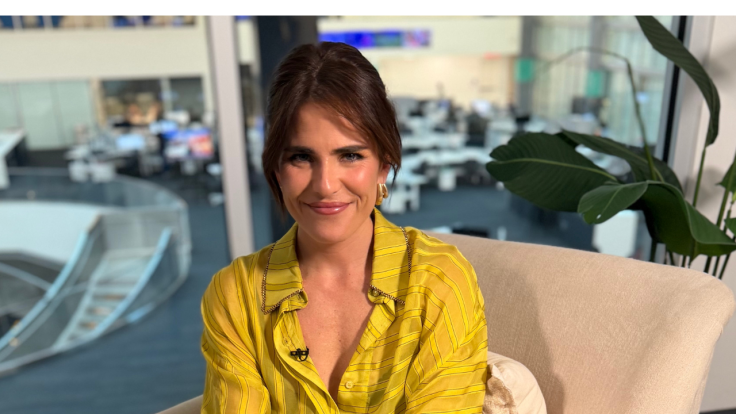
Karla Souza does not buy the idea that Latinos are suddenly thriving in Hollywood.
"People say we're in fashion," she told me during her visit to Miami to promote her series. "But that's not actually true."
As Latin music continues to dominate global charts, stadium tours, and major cultural moments, Souza argues that film and television remain stubbornly behind. The numbers, she says, tell the real story.
"Only 1 percent of all studio films have Latinos," Souza said. "And we represent way more than that in American culture."
The contrast frustrates her, especially when compared with the music industry, where Latin artists have reshaped the mainstream without having to dilute who they are. From global tours to halftime shows, Spanish-language music now drives the culture rather than asking permission to exist within it.
"Music figured it out," Souza said. "Acting hasn't."
That disconnect is part of what makes en 56 Días, her new psychological thriller for Prime Video, so significant. Souza leads the series in English, playing an American character whose ethnicity is never explained or turned into a storyline. The show is based on the novel by Catherine Ryan Howard, and centers on obsession, secrecy, and the dangerous gap between public image and private behavior.
For Souza, that casting alone pushes against Hollywood's default assumptions.
"I think there's this idea that because Latin music is everywhere, acting must be the same," she said. "But it's not easier. There are more opportunities, yes, but that doesn't mean the system has changed."
@aliciacivita_ Karla Souza explica que #Hollywood aún no trata a actores y creativos latinos, como sí lo hace la industria de la música #56days #karlasouza #musicalatina @Prime Video @primevideomx
♬ original sound - Alicia Civita
Souza's own career reflects that dual reality. Though many viewers associate her with Mexican cinema and television, she spent years living in the United States before adulthood, something that often surprises people.
"There are people who think I lived my whole life in Mexico, and that's not true," she said. "I lived five or six years in the U.S. before I was 18, and seven years in Mexico. I've always been split between these two cultures."
That bicultural background shaped both her accent and her professional range, allowing her to move between industries and languages with unusual ease. It also gave her early insight into how differently Latinos are treated depending on the medium.
Souza's relationship to music is also deeply personal. Her brother, Adrián Olivares, was the only Mexican member of Menudo, one of the most influential Latin pop groups of all time. Watching his career up close showed her how music could embrace Latin identity without apology.
"He had so much love for music," she said. "And he loved what I did. He understood this world creatively."

That exposure, she says, helped her understand the difference between industries that expand to include Latinos and those that still gatekeep.
In 56 Days, Souza plays a character who appears morally grounded and controlled, but whose private life is quietly unraveling. The role appealed to her precisely because of that contradiction.
"She should be someone with integrity," Souza said. "But the mess she's in personally could literally end her life. She's very self-destructive."
The performance allowed Souza to explore themes that resonate beyond the thriller genre, including the tension between public facades and private realities. It also gave her space to subtly bring her culture onto the screen, even when it was not written into the script.
In one early episode, viewers catch a glimpse of familiar Latino staples in her character's bathroom. "They asked me what props I wanted," Souza said. "And I said, 'Give me my mini Vicks. Give me Vivaporú.'"
It is a fleeting moment, but intentional. "It's like an Easter egg," she added.
For Souza, those details matter. They reflect a broader push to normalize Latino presence rather than exoticize it. She does not want Latino actors to be treated as trends or exceptions, but as integral parts of the cultural fabric.
"I think what's happening in music is what we hope will happen in acting," she said. "But we're not there yet."
With 56 Days, Souza is not claiming that Hollywood has caught up. She is simply occupying space, leading a major series, and insisting that the industry do the math correctly.
© 2026 MusicTimes.com All rights reserved. Do not reproduce without permission.


